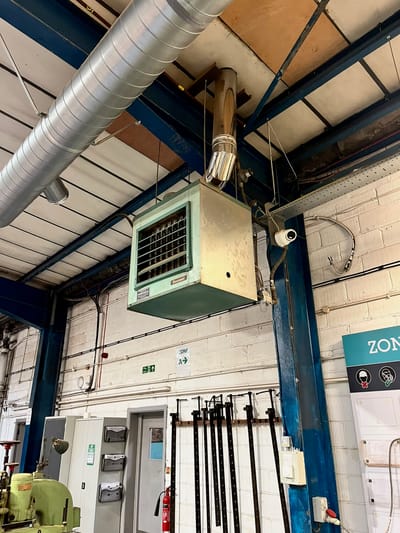
Radiant Tube Heaters for North West Warehouses — Cold-Aisle & High-Bay Issues
Logistics and manufacturing warehouses from Preston to Merseyside rely on radiant tube heaters, yet facilities managers still report icy picking aisles and uneven comfort. Understanding radiant tube heaters for North West warehouses saves energy and complaints.
Why cold aisles persist
- Racking creates shadowed zones where radiant energy cannot reach
- Burner, vacuum fan and tube faults reduce output
- Open loading doors drive cold-air infiltration
- Poor sensor placement and zoning leave floors cold
Maintenance checks
Check burner combustion, ignition, vacuum fan, tube condition, reflectors, gas pressure, sensors and emergency controls. Pair PPM with controls review and sensible door management.
Signs a radiant tube system needs attention
Some tubes run noticeably cooler than others
Heaters lock out and need resetting, especially on cold mornings
Reflectors are dirty, dented or have slipped out of position
Vacuum fans are noisy or slow to start
Staff complain that certain aisles never warm up
What a radiant tube service covers
A proper service checks the burner and ignition, flame detection, gas pressures and combustion readings. The engineer also inspects the vacuum fan, the condition of the tubes and their joints, the reflectors and the flue. Controls and sensors are checked to make sure each zone is responding to the right signal. Faults found during the service are recorded with clear advice on what to fix first.
Fixing cold aisles without adding heaters
Adding more heaters is not always the answer. Often the problem is:
- Racking that has been added or moved since the system was designed, so heat now falls on the tops of racks instead of the floor
- Sensors placed near a door, a heater or in direct sunlight, so the zone switches off too early
- Loading doors left open for long periods
- Reflectors that are dirty or out of line
Reviewing the layout, sensor positions and door management alongside a service can often bring cold aisles back into range.
Planning around the heating season
Book servicing in late summer or early autumn, before the heating is needed. Faults found then can be fixed before the first cold spell, rather than during it.
Read more about radiant tube and warm air heater servicing: https://www.smrgas.co.uk/industrial-heating-radiant-tube-and-warm-air-servicing-1. SMR Gas Maintenance Ltd (Gas Safe 562186) supports radiant tube and warm air plant across the North West. Call 07882 898492 (24/7) or email andy@smrgasservices.co.uk.